Thursday, April 01, 2010

Record Store Day Part I - Playtime

April 17 is Record Store Day, so I thought to myself, what better excuse to talk a little about the record stores that have played such a huge part of my formative years...

Playtime
The first record store I ever visited was Playtime. It was in an old wooden building downtown Trondheim that now houses the pub Three Lions. It pains me to see this former temple of vinyl turned into a house of worship for the anglofiles, but there really hasn't been a decent store there since they closed their doors in the late 80s or thereabout. When you entered the store, they had bins upon bins of vinyl - and they had the mandatory tape racks as well. This was where they kept all the new stuff - the things they still could charge full price for. When I started shopping there, I think the price was around NOK 70 per record or tape, but before too long, the price was around NOK 100, which is the price I remember paying most of the time - as long as the music was new.
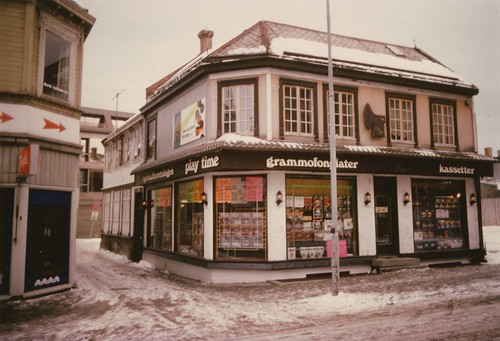


While the main floor was nice and had all the important new releases - especially from the hair bands of the 80s, the basement was the holy grail. Nice Price albums were the main feature of the basement - they were older releases not selling that well anymore and discounted to NOK 49.50. Some were of more foreign origin. I still remember Mexican pressings of Kiss' Love Gun and Rock and Roll Over - and the Black Sabbath box set Hand of Doom, which I also believe could have been of Mexican origin, featuring the first four Black Sabbath albums on flimsy vinyl and without any of the original artwork.

Playtime was also where I purchased most of the presents I ever gave to people. My good friend Arve received many an old ZZ Top tape purchased in this basement - often even cheaper than the NOK 49.50. I think I got him most of the pre-Eliminator releases - and then I made good use of them myself. Copying records and albums to tapes was a very common occurrence, and I think my parents' basement still holds a huge box of tapes I made throughout my adolescence.

I also discovered new music there. I kinda liked what Phil Lynnott had done with Gary Moore (Out in the Fields was a huge hit for the two of them), so I thought I should pick up a Thin Lizzy album. I ended up with Live Life from 1983, which I thoroughly enjoyed, although it was not being recognized as one of their best. I also picked up a cassette once that set my tastes off towards the more progressive music. I had friends who really liked Deep Purple, and it was in the Playtime basement I realized that Ritchie Blackmore had formed another band after leaving Deep Purple: Rainbow. I ended up buying a tape that had a cool cover - the image of a hand coming from a stormy sea and grasping a rainbow. It was called Rainbow Rising. I did not know that the singer was the Holy Diver himself, Mr. Ronnie James Dio, so I was very surprised when I read the cover to find out who played in the band. While I liked the entire tape, the goosebumps appeared when I heard the final track: Stargazer. It still gives me the chills. And for that - and as a tribute to Playtime, which truly was the treasure chest of my youth - here is the original version as recorded by Rainbow in 1976 - and as a nice bonus, a version by Dream Theater from 2009 - eerily close to the original.


Dream Theater - from Black Clouds and Silver Linings:

Friday, March 26, 2010

O Fortuna

When I was 19 years old, Oliver Stones' movie glorifying and mythologizing Jim Morrison was released. I was mesmerized by the movie and by the music - and believe me, I will get back to writing about The Doors again later, no matter how sporadic my entries appear to be - but the movie also introduced me to the music of Carl Orff - specifically O Fortuna from Carmina Burana. The music is powerful, and its usage evoked a similar effect to Kubrick's use of Thus Spoke Zarathustra in 2001: A Space Odyssey - at least to me.

Anyway, The Doors also marks a personal low for me, in that it represents the only time I have left the movie theater before the movie was over - I usually sit through most of the credits if I still can see them (i.e. if people are not blocking the view). I think this is related to the reason I cannot stop buying CDs and go completely digital - I still need those booklets. As an aside, I have to ask what's going on with the DVD booklets that now are virtually non-existent. I guess that people are so used to getting information online that they don't read the inserts anymore... In my defense, when I left the movie before it was over, I was seeing it for the second time (I know, long interjections do disrupt the flow - but I couldn't help myself). Furthermore, it happened during my time as 'russ,' which essentially is a high school senior about to graduate during the week leading up to our national holiday, which is May 17. My friends, who had smuggled beer, or maybe it was moonshine, into the theater, were getting more and more drunk throughout the movie (and I was being my sober self, unfortunately - it means I can still remember this), and one of them just didn't care for the fat, drunken junkie version of Jim Morrison at the end, so he insisted we should leave - and I was actually happy to oblige.

While I am tempted to write more about the time as russ, I think I should get back to the reason I started this little rant, and that was O Fortuna. I recently purchased the CD Unifying Themes Redux by the band Botch, and it had a version of O Fortuna on it that was done just right... Their style is labeled as Mathcore, although I am not sure what that really means. I like the unbridled aggression in every aspect of their music, combined with some very intense freak-out moments, and although it isn't their song, their arrangement of O Fortuna certainly represents this. I got into Botch after discovering Brian Cook in Russian Circles. He is a very interesting bass player, and his chops lay the framework for their very interesting arrangement. He also played in These Arms Are Snakes - and a handful of other bands. I think I need to get back to him a little later - but in the meantime, please enjoy - and play it LOUD!

Tuesday, December 01, 2009

Gong - Master Builder

So I lost it for a year again - but what a busy year it has been. I do think I will talk a little bit more about that later, but today I will focus on Gong and their song Master Builder from the album You, which was released back in 1974.

My history with this song dates 15 years back, to the fall of 1994. That fall I was at Hustad Leir, and I have been writing about this in a couple of other postings as well. I thought I was going there for a 6 week preparative seminar on peaceful conflict resolution before I would be placed in service, hopefully in either Bergen, where I had a lot of friends, or in Trondheim, my hometown. However, that was not to be the case, as I was stationed at Hustad as part of the permanent staff there. The people who were selected to be permanent staff were either the ones too stoned to get placed anywhere or they were Jehova's Witnesses. There were a few other exceptions to that rule, but most of them were also in the extremely religious category.

So there I was, an atheistic teetotaler among stoners and witnesses. As far as I know, I was able to get along with everyone there, and I really liked people of both categories. Hanging out with the stoners there also provided me with a musical education - and that was what led me to Gong. I still remember sitting in one of the four-man rooms, late at night, with an old, worn out tape on the stereo, and when the song Master Builder started, the person owning the tape, whose name unfortunately escapes me (but he was from Nord Trøndelag and I can describe him without any problem) started pounding the air-drums frenetically around 1:20 into the song, ranting and raving about Pierre Moerlen, who was the 21/22 year old drummer who had just joined Gong when You was released.

Now, 15 years later, this song takes me back to that room, dark and smoke-filled (and I don't think that was all nicotine). But more than that, it is a song that gives me goosebumps still, especially when the drum kit enters the picture. The improvisations are solid, but it is the overall looseness and trippy feeling that makes the song for me. It starts with a chant that sounds like it can be from outer space, then the main riff starts quietly in the background before the drum kit helps bring it front and center. With music like this, who needs other recreational drugs?

Thursday, November 27, 2008

Now Be Thankful (Fairport Convention)

My road to Fairport Convention goes through Richard Thompson, and I can guarantee you that both will be revisited in this blog, as I have gained an enourmous respect for both. However, in order to get there, I have to go back to the band that started my Thanksgiving series of songs - ZZ Top. I have already talked a little bit about the start of my civil service in Norway. What I didn't say was that I didn't last 16 months at Hustad Leir. As soon as 1995 rolled around - I had been at Hustad Leir for six months - I was able to leave for Bergen and an assignment at Centre for International Health (CIH), a research institute under the University of Bergen. I moved into a room at Fantoft Studentby, which essentially was an apartment style dorm room way outside the university campus and Haukeland Hospital, which was where CIH was located. I was nervous - I was on my own for the very first time, and although I had very good friends in Bergen, I was far away from home. Some of those nerves were mitigated when I heard familiar music through the wall - it was La Grange from ZZ Top's spectacular Tres Hombres album.

I had been living in Bergen for a very short time when my friend Vegard Nørstebø told me that the local student radio station, Studentradioen i Bergen, were interviewing - and that they were looking for engineers. Studentradioen was an all volunteer radio station - the only paid members were the editors - and I had background from Radio Ung in Trondheim, both as an engineer and a DJ, so I thought it sounded like a good idea. Vegard had already been working there for some time (we had both background from Radio Ung) and was enjoying it, so I saw it as a great way for me to get to meet people as well. I was able to join them, and among the shows I was the engineer for was Plog (the norwegian word for Plow - the noun, not the verb). Plog was an eclectic music program, drawing heavily from traditional music from all over the world - I envision the name as an indication that the music was whatever turned up after one had plowed all corners of the earth. It was hosted by cantankerous Thomas Ekrene - at least he appeared cantankerous to me initially - and I have to admit that I was a little afraid of him. After the show was over, both of us would walk separately down to the bus terminal, get on the same bus (still separately), and take it to Fantoft Studentby, where we both would walk separately to our rooms. Except his room turned out to be right next to me - and he was the guy who had been playing ZZ Top when I first moved in.

After a few weeks of walking separately to the same bus and then the neighboring dorm rooms, we finally started talking to one another. How it happened I don't remember, but the endresult was that we became fast friends - we played together in ad hoc bands assembled for Christmas parties and we eventually became roommates. And in the midst of all this, Thomas introduced me to Richard Thompson, the spectacular British guitarplayer who is a "musician's musician," one who rarely gets the acknowledgment he deserves by the general public, but who is revered by musicians in a variety of genres. The first song I heard was Shoot Out The Lights, and the first album I heard was You? Me? Us?, an ambitious double album produced by Mitchell Froom featuring an electric disk (voltage enhanced) and one acoustic disk (nude). The first Richard Thompson album I bought was Watching The Dark, a 3-cd set stretching from 1988 back to his beginning in a British folk-rock band called Fairport Convention. Among the songs from that time was a song written by Richard Thompson and Dave Swarbrick, Now Be Thankful, a beautiful ballad that seems to be a fitting song for Thanksgiving.

Wednesday, November 26, 2008

Thank You For Hearing Me (Sinead O'Connor)

I remember watching Sinead O'Connor's video for Nothing Compares 2 U, the Prince-penned love song, in my grandparents' living room. They were the only ones in my family who had cable TV, and it included MTV, which I always found curious, being that the cable deal was negotiated with the association where they lived - and they lived in a retirement community at the time where there was no interest for MTV (I should note that cable TV in Norway was about picking channels you wanted at that time - there was no basic distinction between 'basic' and 'expanded' as main package deals. 

While I did like Nothing Compares 2 U and her entire 'I Do Not Want What I Haven't Got' album, I was not prepared to hear 'The Lion and the Cobra', which was her debut album. My very good friend Nina Skaaden (now Schefte) had the album and taped it for me (along with Let Love Rule by Lenny Kravitz, another stunning album). When I popped it in the tape deck and heard Troy for the first time, I was so completely blown away - in fact, I was so enamored by this cute Irish chick with her shaved head that I kept checking out her music even after releasing 'Am I Not Your Girl', an album of standards that was lackluster, to say the least.

Fast forward a few years to 1994. The Norwegian military is based on conscription, which means that all males must serve their country through military service. However, they do allow for conscientious objectors, and as I was (and still am) a pacifist, I was doing my civil service in place of military service. In order to get this approved, I had to be interviewed by the police (I remember a pretty arrogant police officer who certainly didn't appreciate a giant long-haired peace loving guy's perspectives) - and when it was approved, I had to do 16 months of civil service in place of the by then 9 months of military service that was required. 

I showed up at Hustad Leir, a camp that originally had been used for the internment of traitors after World War II (and that now has been turned back into a prison - it wouldn't be a major adjustment), in the summer of 1994, thinking that I was going to the civil service 'boot camp' that lasted six weeks and then find placement for the rest of the time. When I got there, I was in for a surprise. First it was the geography. When you look through the gates of the camp, you see a vertical mountainside. No vegetation, just rock. On the other side was the ocean. There was maybe a mile or so between the camp and the coastline, but you could still almost smell the saltyness of the water. And, to make things even worse, the mist often came rolling in from the sea - or the clouds were trapped by the mountain side and pressed downward, creating an eerie light reflected by the vegetation around the camp (I seem to remember mossy rock, but that may not be true) and sucked up by the dark mountain side. The other part of the surprise was that I was there to be part of their staff. That's right, sixteen months at this desolate place instead of the six weeks. 

My initial assignment was working in the kitchen. While I liked it, I did have another job in mind, and I soon got the opportunity to work in the library there. It was the perfect job for me, surrounded by books and music, with a snooker table and cable tv at my fingertips. The snooker table was heavily used, and it was while playing snooker late at night that Sinead O'Connor's next album was played over and over again. It was called 'Universal Mother', and it is a fairly unknown masterpiece. It spans spoken word set to music (Famine), an excellent cover version of All Apologies (although not as sore as Nirvana's Unplugged version, which was released around the same time), political lyrics (they are all over), and the closing track is this excellent little song called Thank You For Hearing Me. It is built around a programmed drum loop, then instruments are added (mainly programmed on a synthesizer), and the lyrics are sung like a chant with each of the following lines repeated four times:

Thank you for hearing me
Thank you for loving me
Thank you for seeing me
And not for leaving me
Thank you for staying with me
Thanks for not hurting me
You are gentle with me
Thanks for silence with me

The next verse has four different lines

Thank you for holding me
And saying "I could be"
Thank you for saying "baby"
Thank you for holding me

Then she sings the next line four times before finishing a verse that turns the meaning of the song upside down:

Thank you for helping me

Thank you for breaking my heart
Thank you for tearing me apart
Now I've a strong, strong heart
Thank you for breaking my heart

While it can be argued whether this song truly captures the spirit of Thanksgiving, it is nonetheless a spectacular song. She plays around with dynamics and instrumentation, but it is the same melody that is repeated over and over again. So simple, yet so complex - and it adds emphasis to the lyrics. Enjoy this live version of the song. Sinead actually has hair in this one - and she is almost cuter than she was without hair (for my infatuation with bald women, it is safe to assume that Gail Ann Dorsey will be discussed in a later posting - but that will have to wait).


Tuesday, November 25, 2008

Thank You (Led Zeppelin)

There are so many lovesongs out there that it is sometimes hard to find the right one. However, this little song by Led Zeppelin, found on their momentous second album, Led Zeppelin II, has just about everything I could ask for in its lyrics. Yes, it is sappy, but it is sappy in such a good way - just listen to those words:

If the sun refused to shine
I would still be loving you
When mountains crumble to the sea
There will still be you and me

I have to confess that I don't remember the rest of the words, but after looking them up, I decided against citing them here. It did turn a little sappier than I expected - but the four lines above have always moved me deeply. Add to it a cute melody and a spine-chilling guitar workout by master Page, and you have a true masterful love song. And Plant's vocals are outstanding - I have always liked the Unledded version where he goes "bam ba-bam ba-bam ba-bam - I wanna thank you" over the organ punctuated by the guitar/rest of the band. 

However, the Unledded version does lack the rhythm section that really made Led Zeppelin great. John Bonham is unfortunately no longer with us, but John Paul Jones, to me the true unsung hero of Led Zeppelin is still around - and the footage from London's O2 Stadium from last year with Jason Bonham on drums was spectacular. My plea is simple: Robert Plant, please join Jimmy Page and John Paul Jones on an upcoming tour with Jason Bonham on drums. It won't work with anybody else - it's like Queen without Freddie Mercury. If you do, I'll celebrate Thanksgiving every day for a year! 

At that point, my lunch break appears to be over, and I'd better get back to work again. I leave you with the Unledded version of Thank You - please sit back and enjoy!


Monday, November 24, 2008

I Thank You

It's Thanksgiving week here in the United States, and with that in mind, I start a series of songs about thankfulness - or sort of thankfulness. The first band out is that lil' ol' band from Texas - ZZ Top. It really is a shame that most people I grew up with only knew about them from flashy MTV videos with a spiffy car and scantily clad models. At that point they had almost abandoned their trademark blues/boogie rock and were all about click tracks, heavily treated guitars, and synthesizers. Now, there's nothing wrong with that, but when you contrast songs like Gimme All Your Loving', Sharp Dressed Man, and Velcro Fly to classics like La Grange, Tush, and I Thank You (and the list goes on...), there's just no comparison if you ask me.  On the other hand, there are good indications that they will get back to form again after signing to American Recordings and enlisting Rick Rubin to produce their next album.

Anyway - I would in all likelihood have been completely oblivious to the splendor of ZZ Top if it wasn't for Arve Hjalmar Holmen, who has been among my closest (if not the closest) friends ever since he decided that he wanted to take on the biggest kid in class upon returning to our school in sixth grade after a three year absence (that's what living on the wrong side of town for a few years can do to you). A teacher broke us up, which probably was for the better, as I was getting my rear whooped. We were taken inside and told to make nice, and the conversation that started that day has really not stopped - the pauses only get longer, as neither one of us lives in Norway anymore (both of us needed to leave the country to find wives). 

I don't know where Arve got his interest in ZZ Top from or where he had heard them, but the result was that for every birthday and Christmas through middle school I bought him a tape of an old ZZ Top record. ZZ Top's First Album, Rio Grande Mud, Tres Hombres, Fandango, Tejas, Degüello, and El Loco all found their way into his collection of tapes - and I copied them to tapes of my own. Years later, after buying a CD player, the ZZ Top Sixpack was purchased as soon as I could afford it - but Degüello had to be purchased separately, and purchase it I did. It is packed with spectacular songs. I Thank You opens the album, and it hardly ever slows down. Yes, there are a few fillers in there, but most of the songs are so good that Degüello has to be ranked among the best ZZ Top albums. 

The main riff is a pleasure to play - and from the following clip I believe it is possible to see how much they enjoy playing it themselves. This is from Essen, Germany and was recorded on April 19, 1980. I just watched their Live from Houston DVD, but I found it to be pretty bland and boring - all the edge was removed from it. However, back in 1980, when their long beards were still pretty new (and they had all just turned 30 the year before - much can be said about youthful exuberance). Oh - and the song was written by none other than Isaac Hayes...


Saturday, November 22, 2008

Karaim

It is meditation time. Karaim is a piece written by John Zorn as part of his Masada project, which apparently is him exploring his Jewish heritage in a jazz setting. My journey of discovery that landed me with John Zorn really started from two separate directions - and they actually converge here. In 1989, I was starting to explore music outside the realm of the hard rock I mainly had been listening to throughout most of the 80s. Actually, the term we used back then was heavy metal, but with the evolution of that term, most of the bands that used to be called heavy metal are not necessarily called that anymore. 

Anyway, in 1989, I was exploring forms of music that were new to me - such as the brilliant genius Tom Waits. On his records, I started seeing a couple of names: Greg Cohen playing the bass and Marc Ribot on electric guitar. Throughout the 90s I listened over and over again to a tape of Big Time, the concert album - and I eventually got to watch the video as well. Once again, there were Greg Cohen and Marc Ribot. I fell in love with Marc Ribot's sound first and foremost, and I have never been disappointed in anything I have heard from him yet. 

However, I was also still listening to my hard rock (and I still am, which will become more and more apparent as time goes on with this blog), and in 1989 I, along with the rest of the world, discovered Faith No More. Their album The Real Thing was like nothing I had ever heard before, mixing some rap influences with hard rock - but more than that it had an aggression as well as a heaviness that was unprecedented. From there, the road took me to Mr. Bungle, which was the singer Mike Patton's original band. Their eponymous debut album was produced by none other than John Zorn. 

I kept an eye on John Zorn for a while, listening to his Naked City project, which I found to be part virtuoso and part unlistenable. Then, just a couple of years back, I was searching on YouTube, and I discovered both Masada and Electric Masada. Masada has John Zorn on saxophone, Greg Cohen on Bass, Joey Baron on drums, and Dave Douglas on trumpet. Electric Masada includes Trevor Dunn, who played bass for Mr. Bungle, and Marc Ribot as well as Ikue Mori, whom I had heard of through my love for Sonic Youth (check out SYR 5 for more information). Both these bands have performed versions of Karaim, which is a favorite of mine. I should probably warn you that I always have loved songs that stretch and stretch and appear to go on forever, and Karaim is no exception.

The central theme in Karaim is fairly straightforward, but it takes about a minute before it appears in the Masada version - and a little more than seven minutes before it appears on the Electric Masada version. The underlying chords are simple, and the scale used for the theme is pretty straightforward - but the directions they are able to take it in are stellar. 

This is an excellent accoustic version. The interplay between Zorn and Douglas is excellent - and so is the rhythm section of Baron and Cohen. I like the sounds Baron gets out of his kit using his hands rather than sticks - it provides a softness, yet the edge comes through by the use of dynamics throughout the performance:


On another note, I still remember putting Electric Masada At The Mountains Of Madness in the car CD player and turning it up on a sunny spring day - I could have driven forever listening to it. In this clip, which is in the same vein as the At The Mountains Of Madness version, you can watch Zorn directing the group of musicians, controlling the dynamics - they rise, rise, rise and then - bang! - they take it all the way down again. The electric version is divided in two - make sure you listen to the second part as well - that's where Mark Ribot comes in (but Jamie Saft on keyboards has some extremely tasteful moments in the first half - and Zorn himself is on fire!). 

Part 1:


Part 2:

Tuesday, November 18, 2008

Boston

The year was 1996, and the place was the basement of Norwegian School of Economics and Business Administration. The biennial student festival Uken was underway, and it was a cold, snowy winter night. On stage was Steve Wynn Quintet with most of the band Come and Dennis Duck from Steve's old band Dream Syndicate on drums. It was a memorable concert for many reasons, for instance the spectacular performance of John Coltrane Stereo Blues (but more about that song in a later blog, I believe) - and I got to meet Steve backstage before the concert. I was scheduled to interview him, but he was delayed coming in due to bad weather on the mountain passes between Oslo and Bergen, and the local TV-station got first dibs on the interview. As a result, I had a little bit of sound (of poor quality) from the TV interview and then I asked a couple of questions - and I believe I was asking about Johnette Napolitano (formerly of Concrete Blonde), who was someone he had collaborated with before. 

However, for me, the concert ended up being all about the song Boston. It is a classic Dream Syndicate song, and it quotes Van Morrison's Brown Eyed Girl (Do you remember when - we used to sing Sha la la la...). The classic Em-G-D-Em chord progression is the foundation for the song, yet it has a raw power to it that really comes out at the bridge (And the winners stand confused, they don't want to be misused. And the losers that came before say "I don't wanna be here anymore"). 

The band was on fire, and it must have gotten too hot in the basement, because about halfway through the song, the stage went dark, the sound disappeared, and the emergency lighting was the only source of light as Steve Wynn tried singing over the fire alarm. Yup, the fire alarm was ringing, but the audience was not going anywhere. I have been to many a concert where there is an audience participation component or a singalong, but here the audience participated out of necessity. It became a once-in-a-lifetime experience, and while we were all singing the Sha la la's I clearly remember thinking that if there really was a fire, I would die a happy man.

Thinking back on it today, it was probably not a smart thing to do - but there was no indication of any fire (no smoke and no excessive heat). Regardless, it did become one of my most memorable concert experiences. 

I have found two versions of Boston on YouTube - the first is by Dream Syndicate, from their video (now also released on DVD) Weathered and Torn. The second one is accoustic from Steve's 2008 tour - and I believe the second guitar player is Robert Lloyd.


The second one is accoustic from Steve's 2008 tour - and I believe the second guitar player is Robert Lloyd.


Sunday, November 16, 2008

For the Beauty of Wynona

Two years - no blogs. Why? Because it is hard to find the time? Probably. But even more because there hasn't been a passion to get it going. But - on my way home from work on Friday, I listened to NPR as usual, and they featured the writer of the blog Total Music Geek and his ranking of 20 James Bond theme songs. After reading his blog, I realized exactly what I need to do. He has been writing about songs that he wants to highlight, often with a focus on musical, lyrical, and production aspects, and often in a historical perspective. About a decade ago, I used to do something similar on the radio, working at Studentradioen i Bergen. My weekly show was Undertoner - which was turned into Coda, where I over the course of a year explored the history of rock music. Before then, I also hosted a rock show at Radio Ung in Trondheim (Flazz, which turned into Metal Rendez-Vous, which became Madhouse in its final incarnation) over a five year span from 1985-1990 (I was 18 when the radio station had to call it a day). 

Anyway, thanks to Total Music Geek I realized that this blog could be a great way for me to continue exploring (and exploiting) my passion for music of any and all kind - so here it goes, my first attempt in a long time...

When I first saw Daniel Lanois' For The Beauty of Wynona in the music stores, there was a poster with the cover artwork on it, and the naked girl with the knife looked pretty edgy to me. All I knew about him at the time was that he produced U2 and other great artists - and he did that exceedingly well (after all, this was a couple of years after Achtung Baby! was released, an album I still consider groundbreaking). Anyway, I didn't buy the album until I saw it in the clearance bin in a gas station a few years later. I played it through, and wasn't necessarily all that impressed, but the title track was spectacular, and I kept rewinding my tape to listen to it over and over again. 

The song is deceptively simple. It is designed around a G-major chord, which is kept througout the entire verse and bridge with tension being built around the chord. This tension is finally released by the C-major chord that finally that introduces the chorus. A single guitar and a drum loop start the song out, with more guitars, percussion and layers of feedback being added to create a tension that to me is unbelievably cathartic. There are no flashy solos - the electric guitar part has taken a page from the Neil Young one-note solo, and keeps adding to the tension as the song nears the end. If play this song at full volume, I end up both physically and mentally worn out at the end from the varying tensions that are being built - and after the final chorus, there is no additional release - it is all built around the G-major chord. On the album, the song is followed by the quiet and laid-back ballad Rocky World, which gives the ability to breathe normally back to me again. 

I know that my words can't do the song justice, so I would love for you to hear it. However, the only version I have found of it is by Dave Matthews Band. It is a good version, but it belies the droning quality of the original. Download the song (legally, of course) or buy the album - but you should hear this song.